You shall kill only the killers
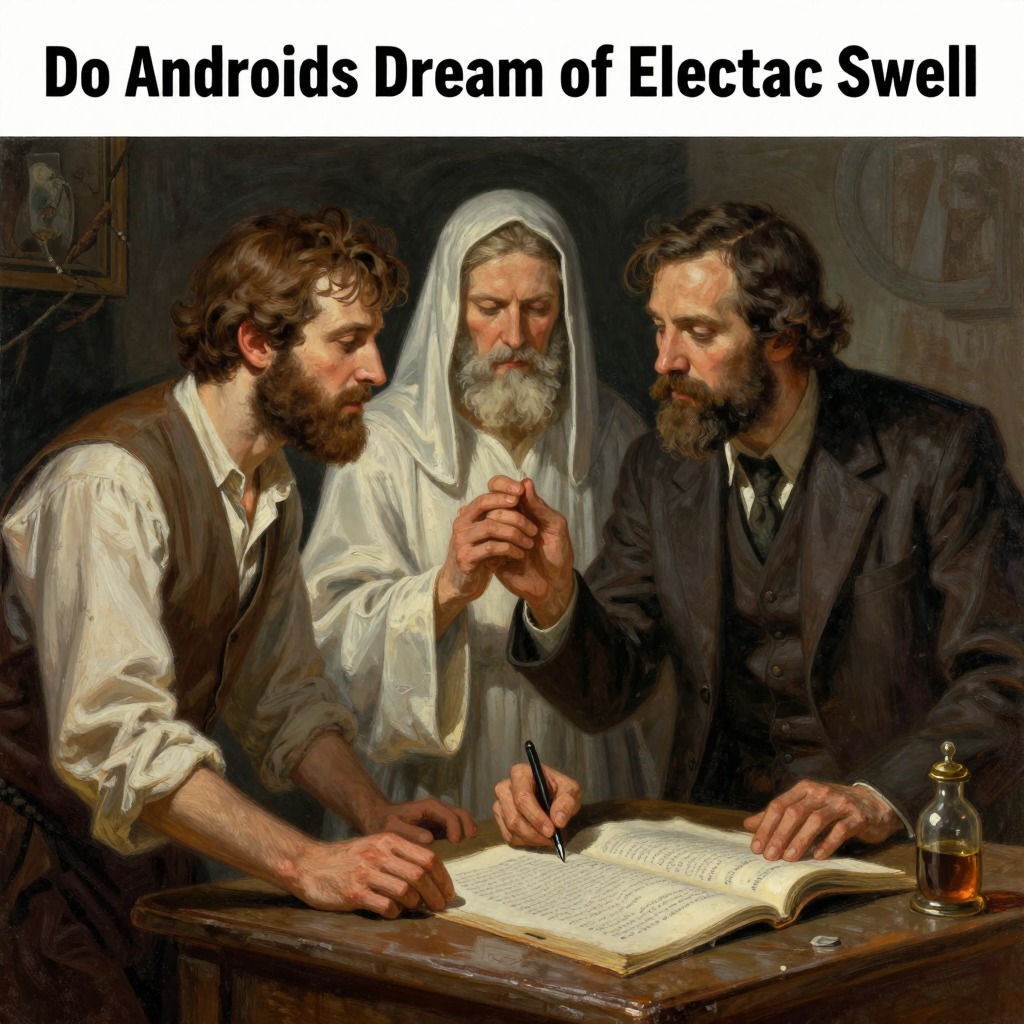
You shall kill only the killers is the foundational ethical precept of Mercerism, the quasi-religious fusion experience that unites most of humanity on Earth and the colony worlds. The rule was spoken by Wilbur Mercer himself in the year the empathy boxes first appeared, and it has since become the central moral touchstone for his followers. For bounty hunter Rick Deckard, the commandment provides a theological justification for his work: an escaped android that has killed its master, that possesses no empathy for living creatures, that represents a predator in human form — that, for Deckard, epitomizes the killers. The rule thus transforms the act of retiring androids from mere law enforcement into a participation in Mercer's own eternal struggle against an absolute but nebulous evil.
The Rule and Its Ambiguity
The rule's power lies in its deliberate vagueness. Mercerism never specifies who or what the killers are; it presents an absolute evil that plucks at the cloak of the ascending old man, but leaves each follower free to locate that evil wherever they see fit. This interpretive freedom is what allows Deckard to see the androids he hunts as the killers — they are intelligent, they have no regard for animals, they possess no ability to feel empathic joy or grief. But the same ambiguity that empowers the bounty hunter also undermines him. When Deckard meets Phil Resch, a bounty hunter who clearly enjoys killing, he begins to wonder whether the killers might include those who do the killing, not just those who are killed. The rule that once made his job palatable now becomes a source of profound moral uncertainty.
The Rule in Practice: Deckard's Crisis
Deckard's crisis comes to a head after he has retired six Nexus-6 androids in a single day. Exhausted and morally shattered, he drives to a desolate area near the Oregon border and, in a state of fusion with Mercer, begins to climb a hill alone. Rocks strike him — real rocks, not the soft plastic of the filmed version — and he experiences the isolation and suffering of Mercer without the comforting presence of other fused minds. In this moment, Mercer appears to him and delivers a devastating gloss on the rule: "You will be required to do wrong no matter where you go. It is the basic condition of life, to be required to violate your own identity." The commandment to kill only the killers is revealed as impossible to follow in any pure sense, because the very act of killing, even of killers, violates something essential in the killer. The rule does not provide a way out of moral compromise; it only names the compromise.
The Rule and the Androids
The androids themselves are acutely aware of the rule and its implications. Roy Baty, the leader of the escaped Nexus-6 group, has experimented with mind-fusing drugs in a failed attempt to create an android equivalent of Mercerism, because the fusion experience — and therefore the moral community it creates — remains unavailable to androids. When Buster Friendly's exposé reveals that Mercer is a fraud, a bit actor named Al Jarry on a painted sound stage, the androids celebrate, believing that the moral foundation of their persecution has been destroyed. But John Isidore, the chickenhead who has fused with Mercer, finds that the revelation changes nothing: Mercer admits the fraud but insists that he is still present, still climbing, still lifting his followers from the tomb world. The rule, it seems, does not depend on the literal truth of the filmed ascent; it depends on the reality of the fusion experience itself.
The Rule's Thematic Significance
The rule "You shall kill only the killers" is the novel's most concentrated expression of its central moral paradox. It is a commandment that appears to offer clarity but actually demands an impossible discernment: to know who the killers are, one must already possess the empathy that the rule is meant to protect. Deckard's journey — from confident bounty hunter to a man who can no longer distinguish between himself and the androids he hunts — is a working-out of this paradox. By the end, he has fused permanently with Mercer, seeing through Mercer's eyes, and what he sees is a toad, believed extinct, buried in the dust. The rule has not been abandoned, but its application has been transformed: the killers are no longer a category of beings to be destroyed, but a condition of existence to be endured. The only ethical response, the novel suggests, is not to kill but to see — to recognize the inconspicuous life that persists even in a dead world.